
Spinal decompression is often described as the sensible alternative to disc surgery. That is roughly right, and too vague to act on. The real question is narrower. Take a herniated or degenerating disc that has not settled with rest, medication and a few months of waiting. Is a course of traction a reasonable use of your time and money?
The answer depends almost entirely on whether your exam findings match the treatment. Computer-guided spinal decompression therapy tends to work for people with a disc-related pattern and pain that radiates into a leg or arm. It fits when nothing on the exam points to a more serious problem. People whose pain is coming from somewhere else can spend twelve visits finding that out.
Dr. Justin Bergin, DC has been having this conversation for 22 years. Here is what decompression does, how well it works, who it fits, and what to ask before you agree to a plan.
Why Does Disc Pain Become Chronic?
Disc pain turns chronic when the mechanical irritation and the nervous system's response start reinforcing each other. The disc stays sensitive and the muscles around it stay guarded. You avoid movement, tolerance drops, and it takes less and less to set the pain off.
It usually starts with nothing dramatic. A disc sits between two vertebrae and absorbs load, and over years of desk work, lifting, old injuries and ordinary aging, the outer wall weakens. Material bulges or herniates, and when it contacts a nearby nerve root you get the classic radiating pain, numbness, tingling or weakness down the leg. Johns Hopkins describes what actually happens when a disc herniates in plain terms. The gradual dehydration and thinning of discs with age explains why so many of these stories start with no single injury at all.
The nervous system keeps it going. Persistent pain reorganizes how the nervous system processes signals, so the original mechanical problem and the sensitivity around it have to be treated together. That is a large part of why medication alone rarely settles it. Understanding how a herniated disc behaves over time also changes what you expect from treatment.
What Does Spinal Decompression Actually Do?
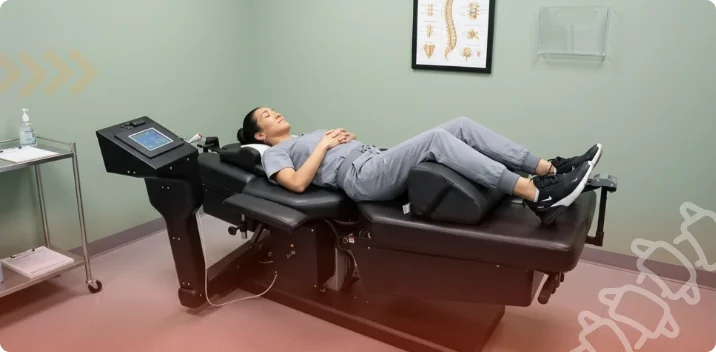
Spinal decompression applies gentle, computer-controlled traction to a targeted segment of the spine. The pull is graded and released in cycles rather than held, which reduces the muscle guarding that makes simple stretching counterproductive. Lowering pressure inside the disc is the mechanical goal.
You lie on a motorized table, harnessed at the pelvis or supported at the head depending on which region is being treated. The table's angle, force and cycle timing are set for your case rather than pulled off a default. The sensation is a slow stretch and release, and most people find it comfortable enough that they relax through it.
The theory is straightforward. Reducing pressure inside the disc makes it easier for fluid and nutrients to move back in. It also gives a compressed nerve root a little more room. It is not a repair procedure, and it does not undo structural damage. It changes load, and changed load is often enough for symptoms to improve.
The Difference Between Traction and a Decompression Plan
A traction table on its own is just a machine. A decompression plan is a sequence of treatments, and the sequence is what produces the result.
At ChiroMed the table is one component. Decompression usually runs alongside adjustments, which improve motion in the segments above and below the involved level. Soft tissue work follows, for the muscles that have been bracing. Rehab builds up gradually so the spine can hold the position it is being given. Cold laser is added when inflammation is a limiting factor. All of it comes from one exam, on one plan, under one Doctor of Chiropractic. That is the part most patients say they could not find elsewhere in Lakeland or The Villages.
There is another model to watch for. A clinic that sells a fixed package of table sessions is selling you a device. There is no reassessment, no change to the plan, and no exercise in that model.
Does Spinal Decompression Actually Work?
For appropriate candidates it may reduce pain, improve mobility and restore tolerance for sitting, standing and walking. It is not guaranteed. Results vary with how long symptoms have been there, what is going on structurally, and whether you do the work between visits.
Most low back pain has a mechanical cause and improves with conservative care. That is good news. It also means some of the improvement people credit to one therapy would have arrived anyway. What a structured plan adds is speed, direction, and a way to tell early whether you are in the responding group.
We measure. If the numbers are not moving by the reassessment point, the plan changes or you get referred. Selling more sessions to someone who is not improving is the most common complaint patients bring us about a previous provider.
What Are the Downsides of Spinal Decompression Therapy?
The real costs are time, consistency and fit. A course of care means repeated visits across several weeks, which is a genuine ask for a working adult. Mild soreness in the first week is common as the tissue adapts.
There are also people it does not suit. Certain fractures, spinal tumours, advanced osteoporosis, some surgical hardware and pregnancy all rule it out or change the approach. Any exam should ask about every one of them. Symptoms that point toward a vascular or systemic cause belong somewhere else entirely.
There is one more limit. Decompression does not rebuild a disc, does not remove arthritis, and does not make a spine immune to what you do with it afterwards. It makes room and reduces irritation. What you build in that time decides whether the relief holds.
Who It Fits, and What Care Costs
The people who do best have back or neck pain that radiates, and symptoms that get worse with sitting or bending. Their exam findings point to one level, and they are willing to do rehab between visits. It works least well for people who want something done to them on a fixed timeline.
Decompression is one part of our disc and nerve rehabilitation program, and we are clear about what it does not replace. Surgery, epidural and nerve-root injections, and prescription nerve medication are not performed here. Each of those is right in its own circumstances. Someone with a confirmed surgical problem and weakness that keeps getting worse belongs in a surgeon's office, not on our table.
On cost, coverage varies by plan and by service, and Medicare rules differ again. The front desk will tell you exactly what applies to you before you commit to anything, and payment plans are available for self-pay care. The one price we publish is the first visit: Consultation, Exam, X-Rays (If Needed) & Report of Findings: Only $47.
Your Next Step
If your back or leg symptoms have outlasted rest and medication, do not start by choosing a treatment. Start by getting a specific answer about what is generating the pain. Then find out whether your case is the kind that responds to unloading the disc.
That takes an exam, a conversation about your history, and imaging where the story and the findings do not line up. You should leave that visit knowing the working explanation and the realistic options. You should also know what would make us say this is not the right approach for you.
Book the $47 evaluation and ask us to walk you through what a decompression course of care involves for a case like yours. Ask what we would expect to see by the reassessment, and what we would do if we did not see it.
Ready to take the next step?
Talk with the ChiroMed team about a spinal decompression plan built around what your examination actually finds.