
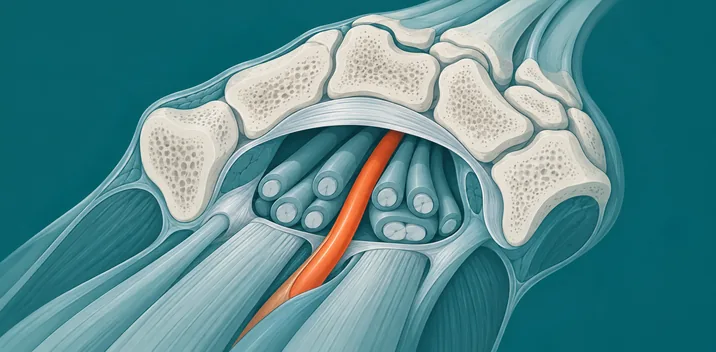
Carpal tunnel release is one of the more dependable operations in hand surgery, and most people who have it done are glad they did. A minority are not. Their numbness and burning either never leave or come back, and a second operation has worse odds than the first one did. A 2023 study asked whether wrapping the nerve in donated umbilical cord tissue changes that. ChiroMed does not provide this treatment. No surgery and no tissue grafting happens at either Florida office. For the conservative side of the same problem, see how carpal tunnel symptoms are assessed at this practice.
Why Is a Second Carpal Tunnel Surgery Such a Difficult Spot?
Symptoms persist or return after a first release in between 1 and 25 percent of patients, with up to 12 percent needing a second operation. The range is wide because studies define failure differently.
The reason revision surgery disappoints is mechanical. Healing after the first operation lays down scar tissue around the median nerve. That scar can tether the nerve and bind it in adhesions, which recreates exactly the compression the surgery was meant to relieve. A surgeon can free the nerve again, and the same healing response can close back around it.
What Did the Researchers Do?
A team at Ochsner Clinic Foundation and the University of New Mexico ran a single-center cohort analysis. Every operation in both groups was performed by the same surgeon, which removes a large source of variability.
The study group was 26 patients who had open revision carpal tunnel release between 2015 and 2018. Each had a cryopreserved human umbilical cord allograft placed around the median nerve. The comparison group was 11 patients operated on by the same surgeon between 2011 and 2015 without it. Mean follow-up across all 37 was about four years, which is long enough to see whether a result held.
They tracked pain, paresthesia, weakness, complications and QuickDASH scores, a standard questionnaire on how the arm, shoulder and hand function in daily life.
What Was the Thinking Behind Wrapping the Nerve?
Cryopreserved umbilical cord tissue contains components that modulate inflammation, and it can act as a physical barrier. The proposed benefit is both of those at once. Calm the local healing response, and put a barrier between the freshly released nerve and the scar that wants to form.
The aim is not to repair the nerve. It is to give it a quieter place to recover in.
What Did the Study Find?
Pain improved in 96 percent of the allograft patients against 73 percent of the controls. Paresthesia, the pins-and-needles numbness that drives most people to surgery, improved in 100 percent against 73 percent. Both of those differences were statistically significant.
Weakness and hand function moved the same direction without reaching significance. Preoperative weakness improved in 90 percent versus 67 percent, and mean QuickDASH scores were 19.0 against 23.7, where a lower number is better. Short-term and long-term complication rates were similar between the groups, so the added tissue did not add risk over four years.
What Are the Limits of This Result?
They are substantial and the authors say so. This was retrospective, not randomized. Thirty-seven patients is a small number, and eleven of them in the comparison arm is smaller still. The two groups were operated on in different time periods, so anything that changed about technique or aftercare between 2011 and 2018 is part of what was compared.
The results that sound most meaningful to a patient, strength and overall hand function, are the ones that did not reach significance. That does not make the study worthless. It makes it a signal worth a larger trial rather than settled practice.
What Does This Practice Do for Hand and Wrist Symptoms?
Nothing surgical, and nothing grafted. The joint and tissue recovery half of the practice works on the mechanical contributors. Those are wrist position at the keyboard and overnight, tendon gliding, and restriction further up the arm and in the neck. Each of those can add load to an already irritated nerve.
Stiffness that persists after an operation is its own category. Care for a hand or spine that stayed stiff after an operation is aimed at the scarred, guarded tissue a healed incision leaves behind. It is not aimed at the surgical result itself.
Some presentations do not belong in conservative care at all. Constant numbness, visible wasting at the base of the thumb, or symptoms that keep progressing are reasons for a surgical opinion. MedlinePlus sets out the warning signs plainly.
What Should You Ask If You Are Facing a Second Operation?
Take the question to the surgeon holding the knife. Ask whether umbilical cord allograft would be appropriate in your case, what they have seen with it, and what the cost and coverage look like. A hand surgeon who has read this literature will have a view, and a direct question deserves a direct answer.
In the meantime, instrument-assisted work on adhesions that limit movement is what this practice can offer alongside whatever a surgeon decides. It targets the forearm and neck restriction that often travels with a sore wrist. New patients start with a consultation, exam, X-rays if needed and a report of findings for $47.
Frequently Asked Questions
Ready to take the next step?
Talk with the ChiroMed team about a soft tissue therapy plan built around what your examination actually finds.